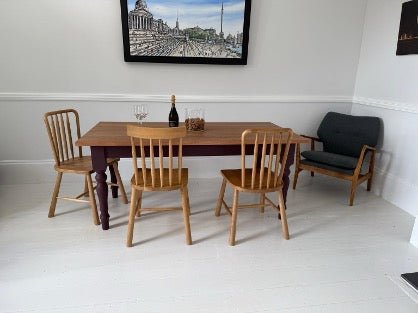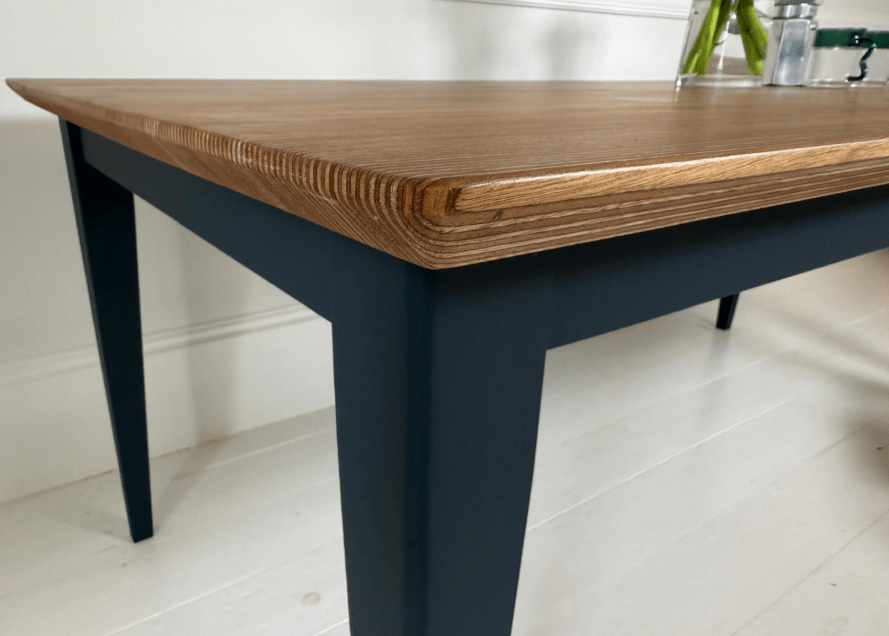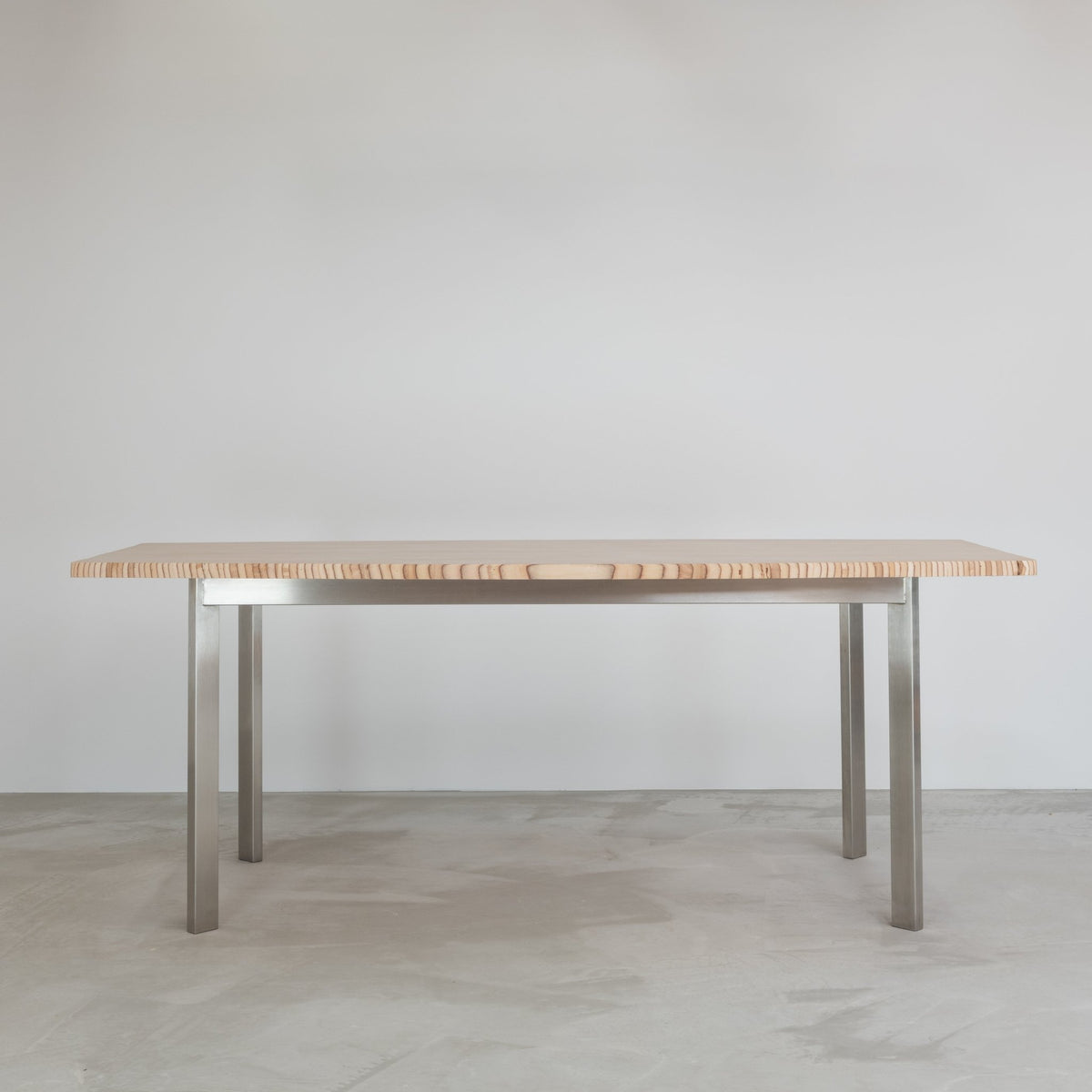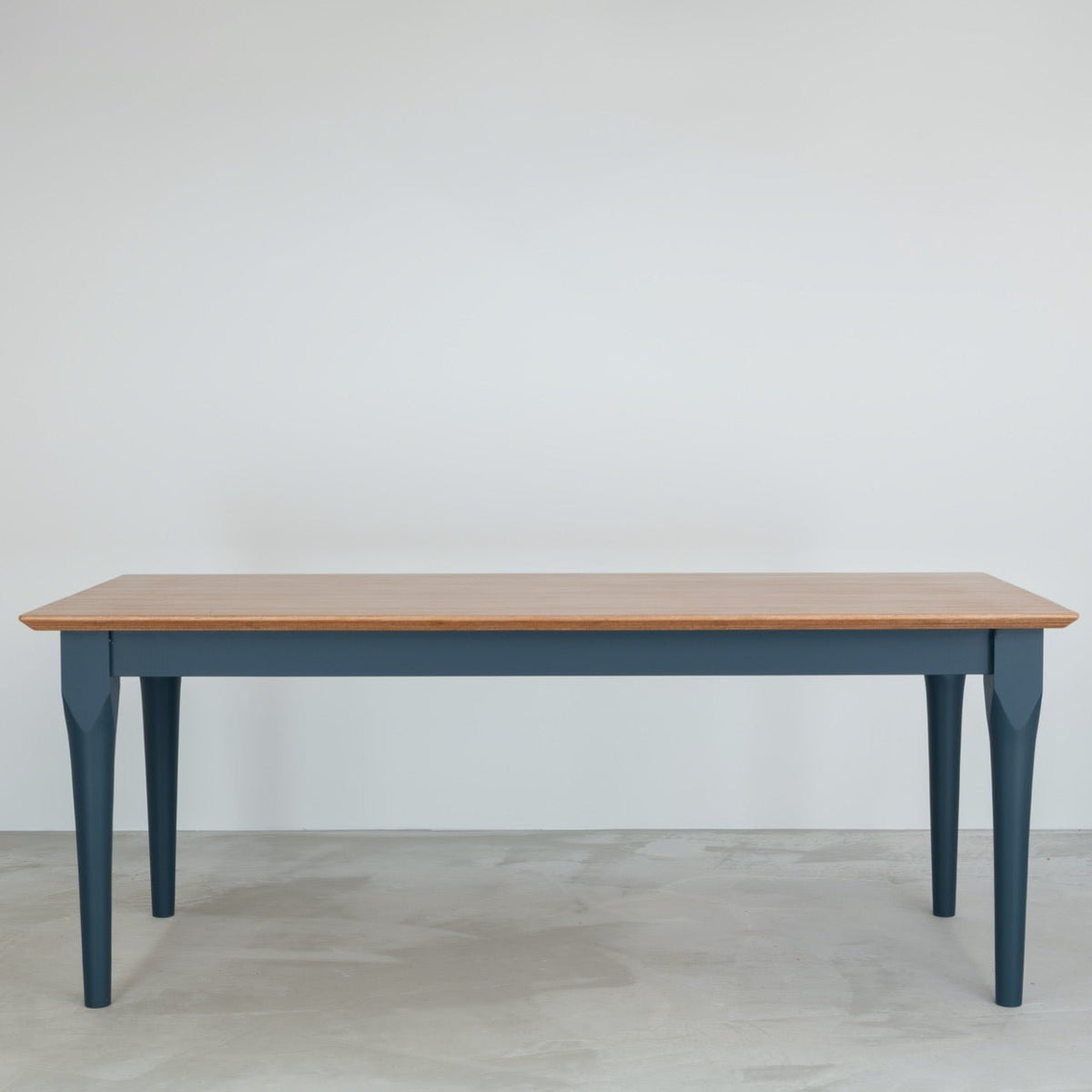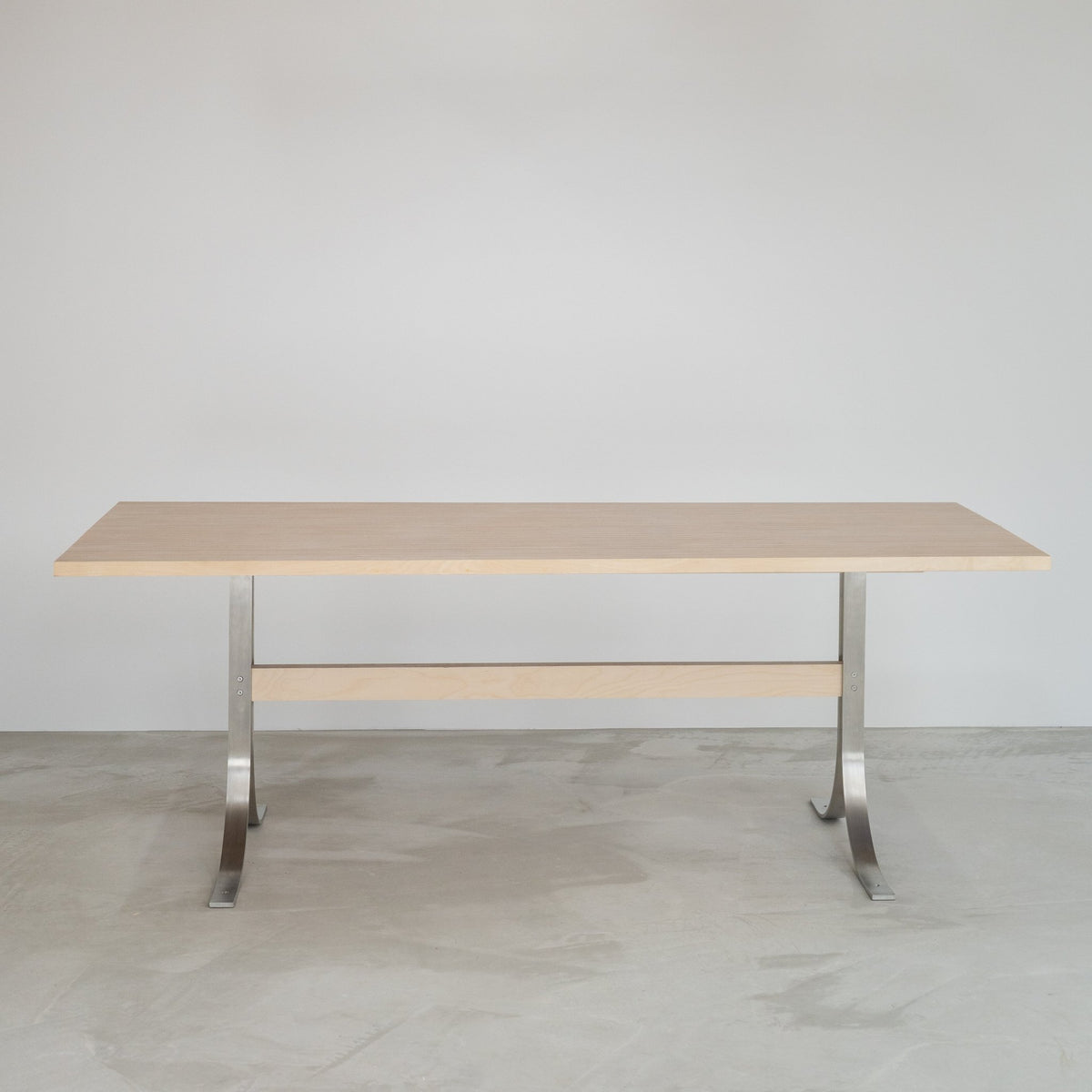
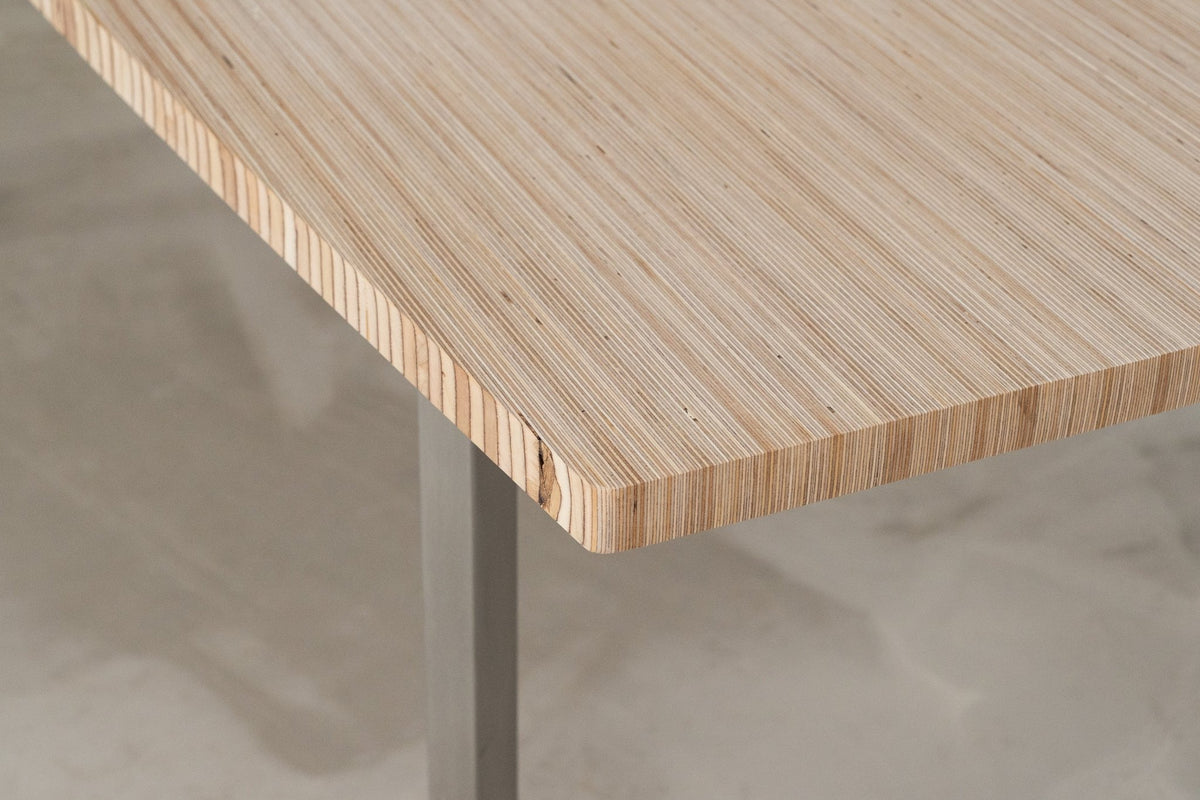
Edge Grain Ply is plywood turned on its side. The sheet is cut into strips and set edge-up, so the layers normally hidden inside become the surface of the table. Every line you see is a layer of real timber - the structure of the sheet, made visible.
It's one of the less obvious materials we design with at Design & Irony. It's also less forgiving than it looks, because it shows everything.
Is Edge Grain Ply real wood?
Yes. It's sometimes taken for something manufactured, but every line is a thin layer of real timber. The clever part is how those layers are bonded: each runs at right angles to the next, which makes Edge Grain Ply far more stable than a top cut from solid planks.
The inside of the sheet becomes the outside
A normal sheet of ply is judged by its faces. The core is out of sight, and for most uses it can stay that way.
Turn the sheet on its side and the core is the surface. Gaps inside the sheet, filler blocks, patched layers, a cheaper core behind good-looking faces - everything a sheet usually hides is suddenly on the table. That's why most ply never makes the cut.
What we rule out
- Ply with unstated or mixed materials. If a sheet can't say what it's made of, the colours tend to be inconsistent and dull. Every strip on a top has to look like it belongs.
- Okoume (Gaboon) marine ply. A respectable marine ply, but too pale for the warm red-brown that Meranti is chosen for.
- "Marine" in name only. Sheets sold as marine glue, marine bonded or simply certified marine, with no construction specification behind the label, are turned away. So is exterior ply sold as marine.
- Batches that vary. In cheaper ply, the outer layers can differ in thickness or colour from the inner ones, and from one batch to the next. On an Edge Grain Ply top, that turns a calm pattern into a busy one.
- Sheets with voids showing at the edge. A gap visible before the sheet is cut means more inside.
The manufacturer matters more than the tree
Voids have less to do with the species of timber than with who made the sheet. For Meranti, BS1088 - the British specification for marine plywood - sets the bar: a hardwood core with no gaps and a marine-grade glue bond. We only use Meranti that carries the BS1088 stamp.
Birch and Poplar have no equivalent stamp. There, the manufacturer's consistency is the only guarantee, so we use manufacturers whose sheets are reliable sheet after sheet. Our Birch comes from mills in Finland and the Baltic states.
Every top is also cut from a single batch. With manufacturers this consistent it matters less than it would, but it keeps the whole surface even.
Checked before it reaches the workshop
Sheets are checked at collection, not once they're in the workshop: the stamp where there should be one, colour consistent with what came before, edges clean and free of voids, and a weight that feels right against previous stock. A sheet that fails any of them goes back.
Why our tops stay flat
Made the conventional way, a top of glued strips can bow across its width and crack along the outer side - and not always straight away.
We've spent years refining a way of making tops that stay flat on their own. How we do it stays in the workshop.
Each top is also given time to settle before it's sanded and finished. Patience is part of the specification.
Thickness is a design decision
Most of our tops are 3cm thick. That isn't a rule. A longer table, or a leg design with more presence, can call for a thicker top to keep the proportions right - and that's judged by eye, not read off a chart.
Long tables and joins
Birch comes in 3m sheets, so a Birch top can run to 3m in one piece. Meranti only comes in 2.4m sheets. Longer than that, a top needs joins - and a join doesn't have to be one straight line across the table. The joins can be staggered along the length: at random, like the boards of a squash court, or in a regular pattern, like a formal floor. Either way, it's decided with you before anything is made.
Strips, curves and angles
Our strips usually run along the length of the table. They can also run across the width, which gives a quite different rhythm.
Shape changes the pattern too. On a round or oval top the layers feather as the edge curves, and an angled edge exposes more of them. The Stingray edge - a 45-degree undercut that leaves a thin rounded lip - takes that idea furthest. On the Acuity, the legs and frame are Edge Grain Ply too.

How it ages
Every material changes with time; the aim is to keep that change to a minimum. On Birch and Poplar, the top coat is a UV-resistant, non-yellowing varnish, so a pale top stays pale. Meranti is finished in oil, chosen to bring out the depth of its colour. The finishes themselves are on our Colours & Finishes page.
Choosing your top
Birch, Poplar, Meranti and Meranti Stingray each read differently once the layers are on show. Table Top Choice compares them side by side - or start a design conversation and we'll talk it through.
 Birch |
 Poplar |
 Meranti |
 Meranti Stingray |